COSMODATA designs and implements comprehensive Structured Cabling solutions for businesses that need a reliable, organized and scalable network infrastructure.
Structured cabling is the foundation on which the following operate:
- corporate networks
- computers
- servers
- Wi-Fi
- IP telephony
- CCTV
- printers
- access control
- meeting rooms
- IoT devices
A properly designed installation reduces problems, simplifies maintenance and creates infrastructure that can support the future needs of the business.
Study & Design
Every project begins with a survey of the site and the actual needs.
We assess:
- number of users
- workstations
- number of network points
- Wi-Fi Access Points
- IP telephony
- CCTV
- printers
- servers
- racks
- uplinks
- future expansions
The design aims not only at current operation but also at the infrastructure's capacity for growth.
Site Survey
Before installation, a technical survey of the site is carried out where required.
The following are examined:
- cable routing
- existing installations
- available channels
- electrical infrastructure
- rack positions
- route lengths
- endpoints
- space constraints
- future needs
Proper preparation reduces changes and delays during implementation.
Data Cabling
We implement data cabling for:
- Workstations
- Servers
- Printers
- IP Phones
- Access Points
- IP Cameras
- Network Equipment
- Meeting Rooms
- IoT Devices
so that every device has a stable and reliable connection.
Copper Cabling
Depending on project requirements, suitable cabling categories can be used, such as:
- Cat5e
- Cat6
- Cat6A
selected based on:
- required speed
- of distance
- environment
- electromagnetic interference
- future upgrade
Fiber Optic Cabling
For backbone connections, longer distances, or high bandwidth requirements, optical fiber can be used.
Indicatively:
- rack-to-rack links
- floor-to-floor connections
- building-to-building links
- server room uplinks
- high-speed backbone
Fiber connections offer high speeds and great resilience to electromagnetic interference.
Horizontal & Backbone Cabling
The infrastructure can be separated into:
Horizontal Cabling
From the rack to the end points of users and devices.
Backbone Cabling
Between racks, floors, buildings or key parts of the infrastructure.
Proper segmentation makes it easier to manage and expand the network.
Network Outlets
Network points are installed with clear logic and proper placement.
Points can be provided for:
- desks
- meeting rooms
- printers
- TVs
- access points
- cameras
- PBX devices
- reception
- server rooms
so that makeshift expansions in the future are avoided.
Patch Panels
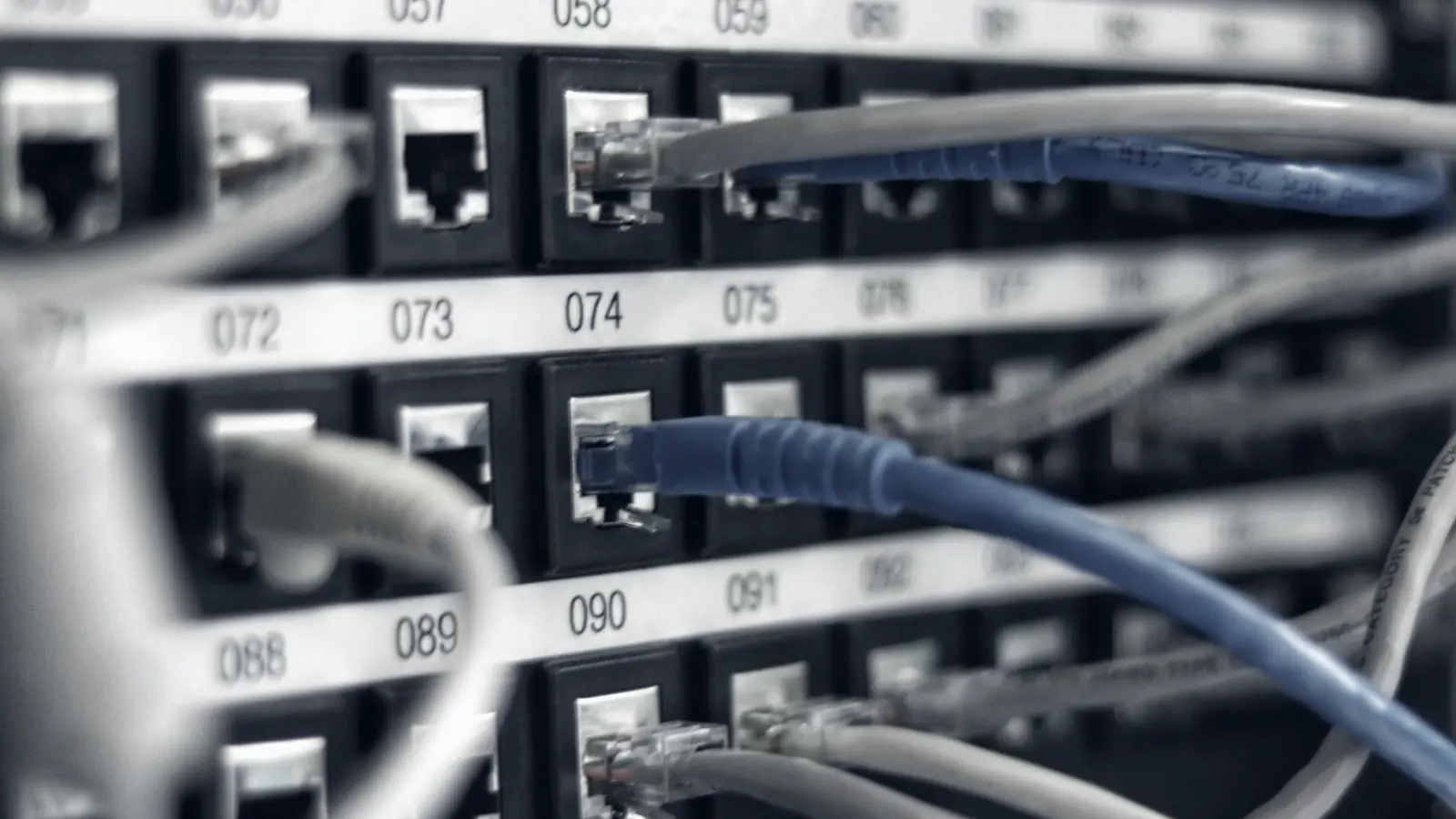
All lines can be terminated in an organized manner on patch panels within the rack.
This enables:
- clean management
- easy troubleshooting
- quick changes
- proper labeling
- better documentation
The patch panel is a critical point of any professional installation.
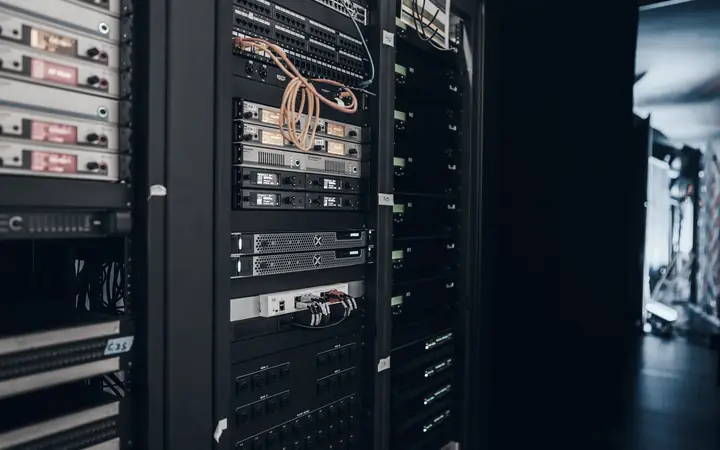
Racks & Data Cabinets
Structured cabling is directly linked to proper rack organization.
We can take over:
- rack installation
- patch panels
- switches
- cable organizers
- PDUs
- UPS
- fiber trays
- patch cords
- labeling
so that the entire infrastructure is clean, functional and easy to manage.
Cable Management
Proper routing and organization of cables is a core part of the installation.
We use appropriate management in order to avoid:
- tangled cables
- excessive bends
- stress on connectors
- difficult access
- errors in changes
A properly organized rack significantly reduces support time.
Labeling
Every line must be immediately identifiable.
The following can be flagged:
- outlet
- cable
- patch panel port
- switch port
- rack
- floor
- room
with a unified naming convention.
This way, troubleshooting is faster and with a smaller margin for error.
Cable Certification & Testing
After installation, cabling tests are performed.
Depending on the project, the following can be checked:
- continuity
- wire map
- cable length
- pair integrity
- signal performance
- termination quality
- link performance
so that it is confirmed that every connection works correctly.
Wi-Fi Infrastructure Cabling
A proper Wi-Fi installation also depends on proper cabling of the Access Points.
We provide for:
- correct AP placement
- appropriate routes
- PoE support
- switch connection
- labeling
- future expansion capability
so that the wireless network is based on a stable wired infrastructure.
PoE Infrastructure
Many modern network devices use Power over Ethernet.
Indicatively:
- Access Points
- IP Phones
- IP Cameras
- Door Controllers
- IoT Devices
Cabling and switches are designed to properly support power and data requirements.
IP Telephony Cabling
IP telephony can use the same structured cabling infrastructure as the corporate data network.
Points can be designed for:
- IP phones
- reception
- meeting rooms
- call center positions
- hotel rooms
- back office
with proper connection to the PBX and the network.
CCTV Cabling
IP cameras require a stable network infrastructure.
We can design:
- camera cabling
- PoE connectivity
- NVR connections
- rack termination
- network segmentation
- UPS protection
so that CCTV is properly integrated into the overall IT environment.
Meeting Room Cabling
Meeting rooms now need more than a simple network point.
Cabling can be provided for:
- displays
- projectors
- cameras
- Teams Rooms
- room controllers
- wireless presentation systems
- phones
- booking panels
so that the space is ready for modern collaboration solutions.
Server Room Cabling
In server rooms, the following can be designed in an organized manner:
- server connections
- storage links
- switch interconnections
- fiber uplinks
- management ports
- redundant paths
- patching
so that the infrastructure remains clean and scalable.
Multi-Floor Installations
In multi-story buildings, a separate rack per floor or zone may be required.
The architecture can include:
so that correct cabling lengths and high performance are maintained.
Multi-Building Infrastructure
In campuses or facilities with multiple buildings, backbone links between them can be designed.
The following can be used:
- fiber
- redundant links
- outdoor-rated cabling
- dedicated network paths
depending on the environment and availability requirements.
New Installations
In new offices or business premises, structured cabling must be designed before the remaining technical work is completed.
We can work with:
- electricians
- engineers
- architects
- contractors
- facility teams
so that all necessary data points are planned from the start.
Renovations
In existing buildings, we can reorganize or extend existing cabling.
Tasks may include:
- new cabling
- replacement of old lines
- new sockets
- rack reorganization
- new patch panels
- removal of abandoned cables
- relabeling
- recertification
so that the infrastructure regains a clean and controlled structure.
Office Relocation
Relocating a company to a new space requires proper network infrastructure design.
We can organize:
- capturing a new space
- data outlets
- Wi-Fi points
- rack
- server room
- PBX connectivity
- printers
- meeting rooms
- CCTV points
so that the technology infrastructure is ready before users are relocated.
Hotels & Hospitality
In hotel facilities, structured cabling may cover:
- guest rooms
- reception
- offices
- restaurants
- conference rooms
- Wi-Fi
- PBX
- CCTV
- POS
- back office
- server rooms
with central design so that different systems can coexist in the same organized infrastructure.
Retail & Branch Networks
For stores and branches, provisions can be made for points for:
- POS
- workstations
- printers
- access points
- CCTV
- phones
- digital signage
- network equipment
so that all sites follow a common corporate standard.
Warehouses & Industrial Spaces
In larger or more demanding spaces, infrastructure can be designed for:
- warehouse Wi-Fi
- terminals
- scanners
- cameras
- access control
- network cabinets
- long-distance links
taking into account the particular conditions of the installation.
Network Segmentation Ready
The physical infrastructure must also support the logical design of the network.
Properly organized cabling makes it easier to separate:
- corporate users
- servers
- voice
- guest Wi-Fi
- CCTV
- IoT
- printers
in different VLANs and security zones.
Redundancy
In critical installations, alternative paths or additional connections can be provided for important systems.
Indicatively:
- dual network links
- redundant fiber
- secondary racks
- redundant uplinks
so that a failure does not cause a total loss of connectivity.
Documentation
Upon completion of the project, technical documentation can be delivered, such as:
- cable numbering
- outlet mapping
- patch panel mapping
- rack layout
- network diagrams
- floor plans
- test results
- equipment information
so that the installation is fully documented.
As-Built Documentation
The final documentation must capture the project as it was actually implemented, and not only as originally designed.
This way, future:
- extensions
- changes
- troubleshooting
- migrations
can be carried out faster and with greater accuracy.
Preparing for Future Growth
Structured cabling has a much longer life cycle than many active network devices.
For this reason, it must be designed with a long-term horizon.
We provide, where it makes sense:
- additional ports
- spare rack capacity
- backbone capacity
- new workstations
- additional access points
- new systems
so that every small change does not require a new cabling project.
From the Physical Layer to the Business Network
Network infrastructure starts at the physical layer.
An expensive firewall, a fast switch or a modern Wi-Fi system cannot perform properly when the cabling is faulty.
For this reason, we treat structured cabling as the foundation of the entire IT environment.
Real value is created when the physical and active network infrastructure are designed together.
COSMODATA can combine:
so that the project is delivered as a complete solution and not as independent tasks.
From Installation to Management
After the project is completed, the infrastructure can be included in Managed IT Services.
This creates continuity:
and the same infrastructure can be monitored and supported over time.
Why Professional Structured Cabling
Reliability
Stable connections and proper installation quality.
Better Performance
The infrastructure can support the required speeds without unnecessary limitations.
Easier Maintenance
Labeling, patching and documentation reduce troubleshooting time.
Future Scalability
The installation is designed so that it can grow.
Better Security
An organized physical infrastructure supports proper network segmentation and access control.
Lower Long-Term Cost
A proper installation reduces makeshift extensions, failures and repetitive work.
The infrastructure you don't see is what supports everything
COSMODATA treats Structured Cabling as a fundamental part of every serious IT project.
From a small office to a multi-story building, hotel, or multi-site environment, we design the infrastructure based on performance, organization, and future scalability.
Because before Wi-Fi, the cloud, the PBX, and applications, there is always a physical network that must work properly.
Built Right. Connected Right. Ready for Growth.